Research
Research Interests
My research focuses on wave propagation, topological control, and intelligent design in architected materials and structures. I am particularly interested in the band theory of phononic crystals and wave metamaterials, the formation and classification of mechanical topological states, and topological wave phenomena in curved and complex geometries. My current work explores curvature-enabled topological phase transitions and topological pumping, using geometry, non-Hermiticity, and nonlocal interactions to achieve robust and programmable wave and energy transport. In parallel, I develop structural topology optimization and AI-assisted inverse design methods to connect desired wave functionalities with realizable material architectures. By integrating theoretical analysis, numerical modeling, optimization, and experimental validation, I aim to bridge fundamental topological mechanisms and engineering applications, with an emphasis on on-chip surface acoustic wave devices and lightweight structures for vibration and noise control.1. Topological Mechanics and Wave Dynamics
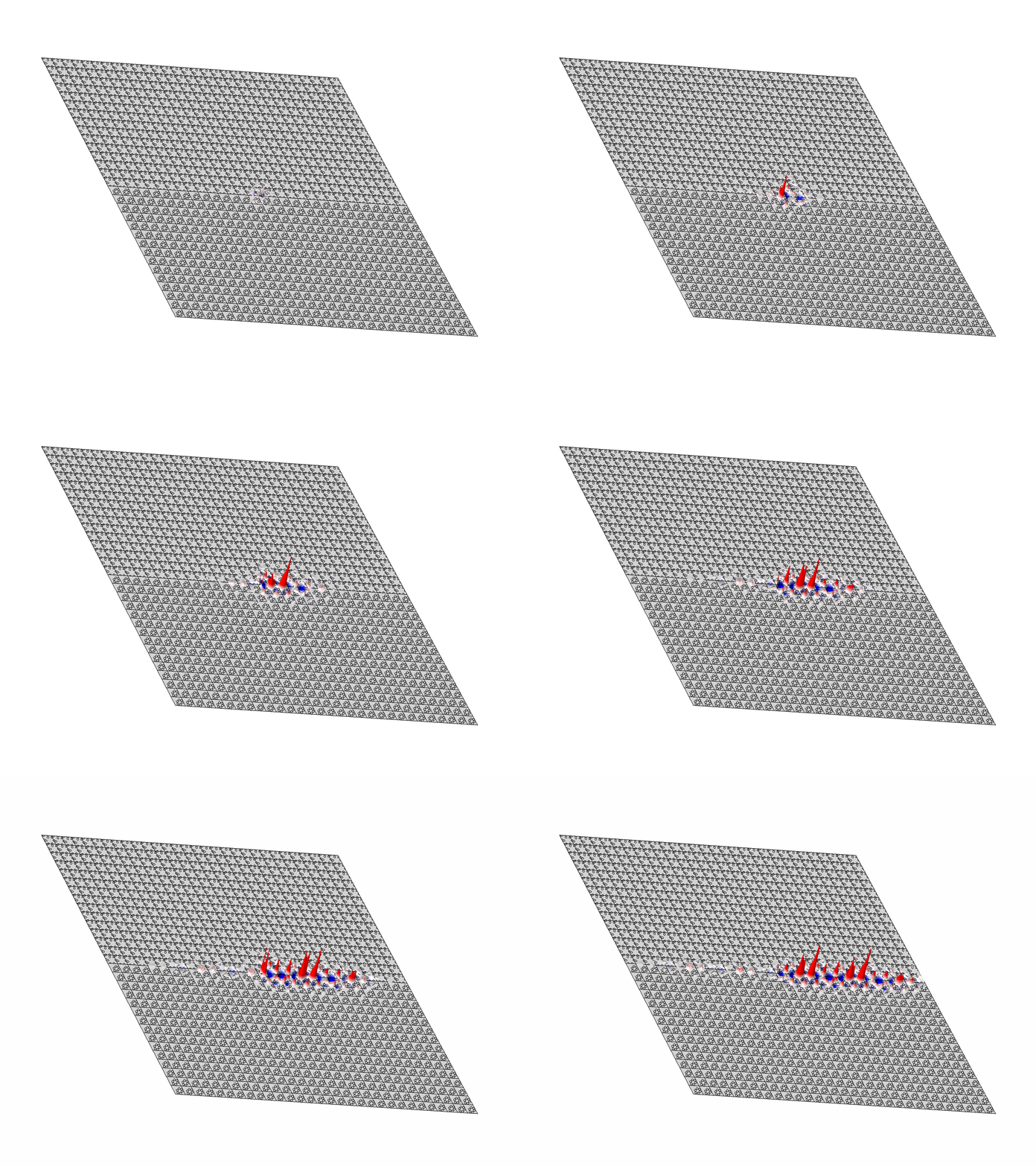
We investigate the physical mechanisms governing wave propagation and topological states in phononic crystals and mechanical metamaterials. Particular attention is paid to how geometry, symmetry, and interactions shape band structures, localized modes, and energy transport. Our goal is to establish new routes toward robust and programmable wave control in complex mechanical systems.
- Topological states and phase transitions: Formation, classification, and manipulation of mechanical topological phases, including higher-order topology and localized boundary states.
- Curvature-enabled topology: Exploring geometric curvature as a design variable for controlling topological phases and elastic waves in curved lattices and shells.
- Topological pumping and energy transport: Controlling wave transfer through spatial modulation, non-Hermitian effects, and nonlocal interactions.
2. Topology Optimization and Intelligent Inverse Design

We develop computational methods that translate target wave functionalities into realizable material architectures. By combining structural topology optimization, physical insights, and artificial intelligence, we seek to improve design efficiency and expand the range of achievable topological and wave-control functionalities.
- Explicit topology optimization: Developing moving morphable components (MMC) formulations for phononic structures, topological materials, and waveguides.
- Physics-guided inverse design: Incorporating symmetry indicators, band structures, and modal characteristics into optimization formulations.
- AI-assisted structural design: Combining machine learning, surrogate models, and generative approaches to accelerate the discovery of functional microstructures.
- Multiphysics and manufacturability: Coordinating mechanical and acoustic performance while accounting for geometric, material, and fabrication constraints.
3. Wave-Functional Structures and Engineering Applications
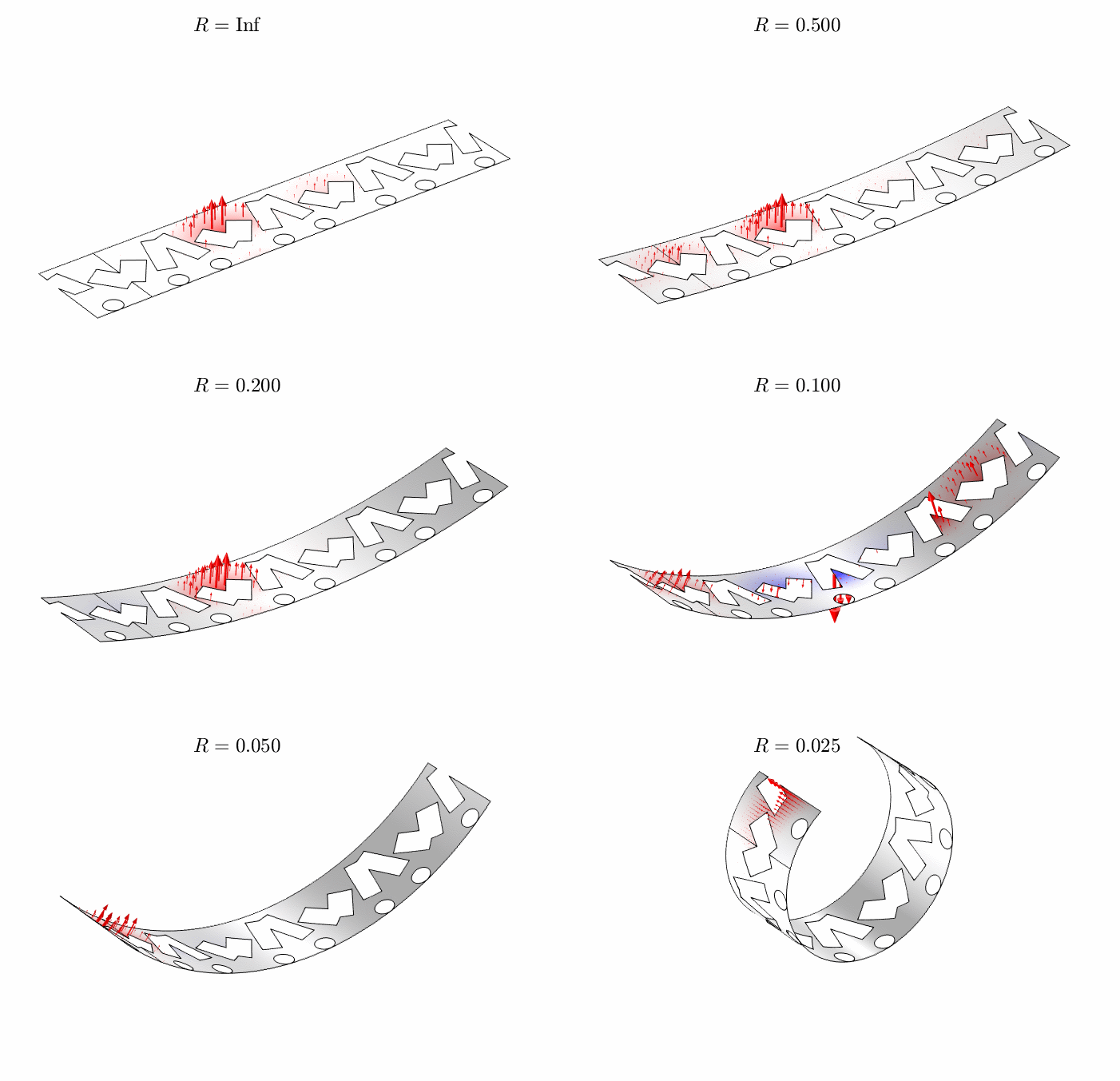
We translate wave-control mechanisms and advanced design methods into devices and structures for engineering applications. Our work emphasizes the coordinated design of load-bearing capacity, vibration suppression, acoustic performance, and energy transport, supported by numerical analysis and experimental validation.
- On-chip acoustic devices: Designing topological surface acoustic wave devices through coordinated optimization of material orientation, structural geometry, and electromechanical coupling.
- Integrated structural and acoustic functions: Developing lightweight load-bearing structures with tailored vibration transmission, sound insulation, and energy dissipation.
- Engineering validation: Evaluating functional structures under practical loading, boundary, and environmental conditions for aerospace, low-altitude aircraft, and other major engineering systems.
Selected Research Activities
- On-chip topological surface wave devices: NSFC Young Scientists Fund, Category C (Principal Investigator, 2026–Present).
- Lightweight design of a load-bearing turntable for engineering equipment (Principal Investigator, 2026–Present).
- Development of DLUTopt, a structural topology optimization software platform (Participant, 2022–Present).